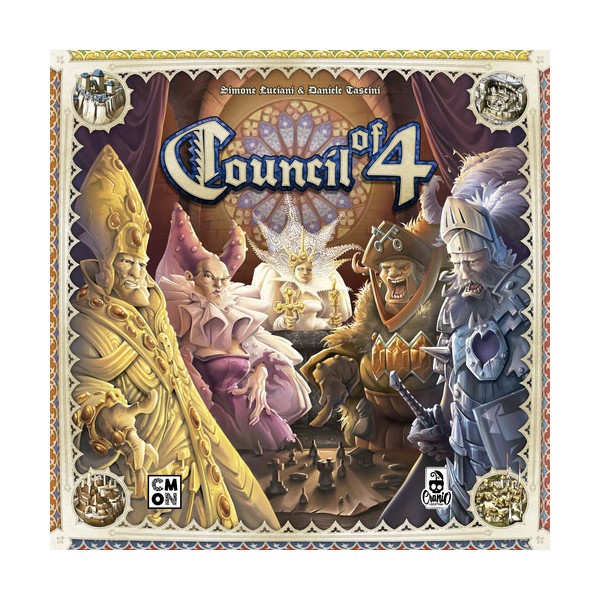
The Empire, formed by three Kingdoms, has a period of wealth and prosperity. Each Kingdom is governed by a council of four nobles. The members of six influential families sit around in the councils and lead the Kingdoms. Players hold the roles of rich merchants who seek to obtain permits to build their own Emporium inside the cities of the three kingdoms. Whoever take more permits, while also placing their Emporium in the best places, will be the most famous merchant and will win the game. But pay attention to the Emperor! He can allow you to build without permits!
On a turn in Consiglio dei Quattro ("Council of Four"), a player can perform different actions:
The main action is to corrupt a council, which is represented by a slide with four noble's pawns. By corrupting the three Kingdom's councilors, the player gets permits cards that give various instant and game end benefits, and the possibility to build an Emporium in a specific city.
Another action is to play a permission card to build an Emporium. Each emporium earns the player the special benefits of the space where it's built, but also activates all connected emporiums, with a chain effect.
Corrupt the Emperor’s council to allow a player to build Emporiums without permission cards.
Players can change the composition of a council.
There are many different way to earn points:
Build a connected Emporium in the cities that earn points.
Build your emporium in all the city of an area of the board area: faster you complete the area more points you earn.
Move up on the nobility’s track
Obtain permits that give points
The board is modular and has eight possible combinations.
https://dev.dracotienda.com/juegos-de-tablero/20560-council-of-4.html20560Council of 4<p><strong>Edición en inglés.</strong></p>
<p>The Empire, formed by three Kingdoms, has a period of wealth and prosperity. Each Kingdom is governed by a council of four nobles. The members of six influential families sit around in the councils and lead the Kingdoms. Players hold the roles of rich merchants who seek to obtain permits to build their own Emporium inside the cities of the three kingdoms. Whoever take more permits, while also placing their Emporium in the best places, will be the most famous merchant and will win the game. But pay attention to the Emperor! He can allow you to build without permits!</p>
<p>On a turn in <em>Consiglio dei Quattro</em> ("Council of Four"), a player can perform different actions:</p>
<ul>
<li>The main action is to corrupt a council, which is represented by a slide with four noble's pawns. By corrupting the three Kingdom's councilors, the player gets permits cards that give various instant and game end benefits, and the possibility to build an Emporium in a specific city.</li>
<li>Another action is to play a permission card to build an Emporium. Each emporium earns the player the special benefits of the space where it's built, but also activates all connected emporiums, with a chain effect.</li>
<li>Corrupt the Emperor’s council to allow a player to build Emporiums without permission cards.</li>
<li>Players can change the composition of a council.</li>
</ul>
<p>There are many different way to earn points: </p>
<ul>
<li>Build a connected Emporium in the cities that earn points.</li>
<li>Build your emporium in all the city of an area of the board area: faster you complete the area more points you earn.</li>
<li>Move up on the nobility’s track</li>
<li>Obtain permits that give points</li>
</ul>
<p>The board is modular and has eight possible combinations.</p>https://dev.dracotienda.com/143822-home_default/council-of-4.jpg54.95outofstockCool Mini or Not59.950145.41328.34043646299175.00012018-07-12T10:38:00+0200/Juegos de Tablero

 Al comprar este producto puedes recolectar hasta
5
puntos.
Su carrito totalizará 5
puntos que se puede convertir en un vale de
1,00 €.
Al comprar este producto puedes recolectar hasta
5
puntos.
Su carrito totalizará 5
puntos que se puede convertir en un vale de
1,00 €.