

No hay productos en la cesta.
 Al comprar este producto puedes recolectar hasta
2
puntos.
Su carrito totalizará 2
puntos que se puede convertir en un vale de
0,40 €.
Al comprar este producto puedes recolectar hasta
2
puntos.
Su carrito totalizará 2
puntos que se puede convertir en un vale de
0,40 €.

Pago seguro por tarjeta, transferencia o contrareembolso

Envío gratuito desde 60 euros de compra

Garantía de devolución 15 días
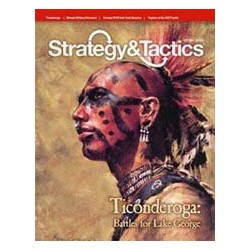
Ticonderoga simulates six engagements in the region between the upper Hudson and
lower Lake Champlain, specifically the area between northern Lake George and Fort
Carillon (a.k.a. Ticonderoga) during the French and Indian War (1755-58). The game system
emphasizes the importance of leaders, and highlights the role of individual command
skills, circumstances and luck. Throughout the game, leaders’ skills are tested as their
units maneuver and fight, and every leader has the capacity to be “inept,” “capable” or
“exceptional,” varying from engagement to engagement.
The game includes a lot of randomization; so every game may vary in tempo. One game
may involve more soldiers than another, and often the quality of the lower-level (unnamed)
leaders will be different. There are three campaign and three raid scenarios, featuring
many units for the longer games and fewer for shorter ones (280 counters total). Each
hex on the Strategic Map represents 1.5 miles, whereas each hex on the Tactical Map (for
the area near Ticonderoga) represents just 400 yards. Individual units represent from 50 to
800 men, and leader chits each represent a single commander, sometimes a famous historical
figure, at other times an unknown man of low-rank.
ARTICLES: Mongol Military Disasters. An analysis of the Mongol invasions that
failed, leading to the stagnation and eventual end of their empire. German WWI Anti-Tank Doctrine. The Germans fielded few
tanks in the Great War; instead, they were the first to concentrate on how to destroy them. Capture of the USS Peublo. Analysis
of how this US Navy intelligence-gathering ship came to be captured by the North Koreans in 1968.