
No hay productos en la cesta.
 Al comprar este producto puedes recolectar hasta
4
puntos.
Su carrito totalizará 4
puntos que se puede convertir en un vale de
0,80 €.
Al comprar este producto puedes recolectar hasta
4
puntos.
Su carrito totalizará 4
puntos que se puede convertir en un vale de
0,80 €.
Edición en inglés

Pago seguro por tarjeta, transferencia o contrareembolso

Envío gratuito desde 60 euros de compra

Garantía de devolución 15 días
Edición en inglés.
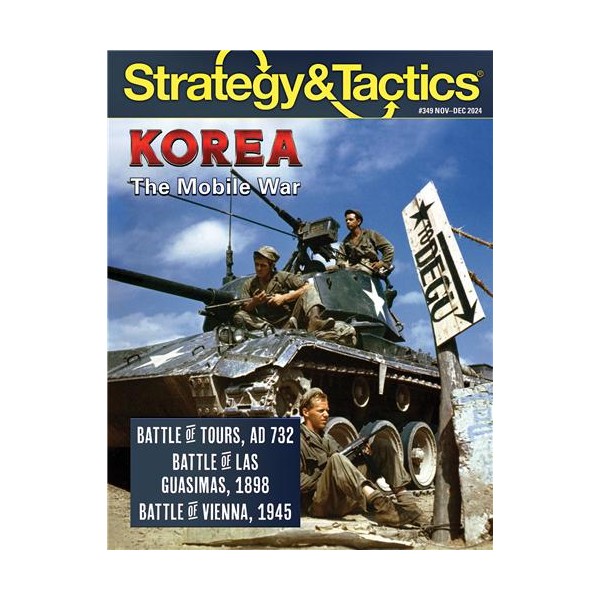
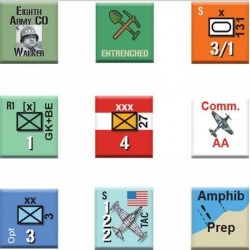
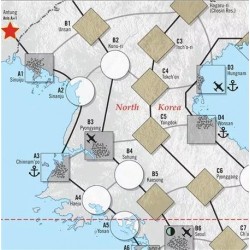
Korea the Mobile War (1950-51) is a solitaire wargame covering the first year of the Korean War (July 1950 to June 1951). The game covers the critical mobile stage of the war when a decisive victory was in the cards. Historically, this phase ended in a stalemate with the front stabilized at the 38th parallel. The player controls the United Nations Command (UNC) while the game system controls Communist forces. The objective for the player is to gain the decisive victory that proved elusive in 1950-51. The game rules provide asymmetrical capabilities for each side. There are also options for the employment of additional UNC forces and US nuclear weapons. While a solitaire game, two or more players can also play Korea, each taking charge of different UNC forces.
Each game turn represents one month of operations. The map is set at 30 miles to the inch. Most combat units are corps, divisions, and brigades/regiments.
Additional feature articles:
· The Battle of Tours: Facts & Suppositions On 10 October 732, the battle that dictated the fate of Europe for the next 1,000 years took place. An army of Franks under Charles Martel faced a Muslim one under Arab general Abd al-Rahman al-Ghafiqi. In the West, the engagement became known as the Battle of Tours; in the Islamic World, it is called the Battle of the Highway of the Martyrs.
· The Battle of Las Guasimas: 24 June 1898, The Battle of Las Guasimas de Sevilla, Cuba, was fought on 24 June 1898, during the Spanish American War. Considered that conflict’s first land engagement, it saw Spanish forces fight a delaying action against an American column moving through the jungle toward Santiago. Studying the weapons and tactics of both sides goes far to explain the outcome of the larger campaign on Cuba.
· The 1945 Soviet Vienna Offensive The Soviet Vienna offensive began in March 1945, when their Second and Third Ukrainian Fronts penetrated the defenses of Army Group South between Esztergom and Lake Balaton in Hungary. The offensive continued until mid-April, only stopping after the Soviets captured Vienna. Here is our analysis.
Edición en inglés