
No hay productos en la cesta.
 Al comprar este producto puedes recolectar hasta
2
puntos.
Su carrito totalizará 2
puntos que se puede convertir en un vale de
0,40 €.
Al comprar este producto puedes recolectar hasta
2
puntos.
Su carrito totalizará 2
puntos que se puede convertir en un vale de
0,40 €.

Pago seguro por tarjeta, transferencia o contrareembolso

Envío gratuito desde 60 euros de compra

Garantía de devolución 15 días
Edición en inglés.
Several times a year, when we feel like it, the Golden Journal brings Gold Club members some fun extras for their Avalanche Press games. Our new-model Golden Journal features a “real” booklet, just like a small magazine, and a small set of die-cut, silky-smooth playing pieces.
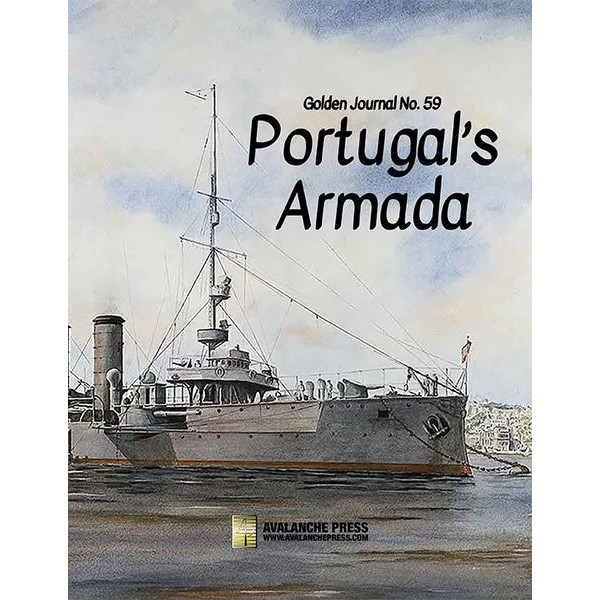
Golden Journal No. 59: Portugal’s Armada is for Great War at Sea, with 23 new die-cut and silky-smooth pieces. Portugal was a desperately poor country, and this influenced naval development more than any other factor. They desired a fleet to protect their colonies from British and German encroachment, but could not really afford it.
There are four distinct eras of Portuguese naval construction covered in Golden Journal No. 59, only one of which actually happened. First, you get the existing fleet; this has two “long” ship pieces: an ironclad re-built into a coast defense ship. They went cheap and instead just wasted the money. They also have a crapulent Elswick-built cruiser.
The 1907 program is sometimes described as including two “dreadnoughts,” but the design the Portuguese chose was a coast-defense ship, because it was cheaper. They also had cruisers (in reality, small coast-defense ships) to accompany them.
The 1911 program went to three larger ships, but still smaller and cheaper than contemporary dreadnoughts. Vickers Design 702 looked a little like the new British super-dreadnoughts, but had 12-inch rather than 13.5-inch main guns and was much smaller. Again, the program had cruisers as well.
Finally, in July 1921 the U.S. Navy’s Second Battleship Squadron visited Lisbon, with the dreadnought Utah attached and its own six Connecticut-class pre-dreadnoughts. Portuguese naval and political leaders toured the ships, and at some point during a formal dinner squadron commander Charles Frederick Hughes passed along an offer to sell the dreadnought and five of the pre-dreadnoughts. Once again, the Portuguese passed due to the costs.