
No hay productos en la cesta.
 Al comprar este producto puedes recolectar hasta
5
puntos.
Su carrito totalizará 5
puntos que se puede convertir en un vale de
1,00 €.
Al comprar este producto puedes recolectar hasta
5
puntos.
Su carrito totalizará 5
puntos que se puede convertir en un vale de
1,00 €.
Edición en inglés

Pago seguro por tarjeta, transferencia o contrareembolso

Envío gratuito desde 60 euros de compra
Garantía de devolución 15 días
Edición en inglés.
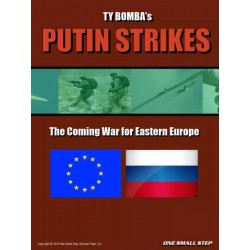
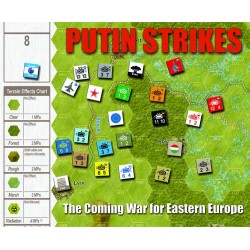
Putin Strikes: The Coming War for Eastern Europe is a two-player game (solitaire suitable) in which one player (the Russian player) commands the Kremlin's forces, and the other (the Allied player) commands a polyglot international coalition opposed to him.
This near-future what-if is set at 20 miles per hex, with divisions and brigades as the units of maneuver. It covers the first month of the war that could result if Putin decides to abandon the "opaque war" (a.k.a. "gray war") approach and go for it big time.
The idea being to take advantage of the West's (particularly the "old NATO" countries') distraction with the jihad to try to win back all or some of the "Near Abroad" on Russia's European flank.
Before you ask: the difference between this game and "Putin's War," which will be appearing in an upcoming issue of Modern War, is that "Putin's War" is a strategic (army-corps at 55 miles (90km) per hex) treatment with operational undertones, whereas the present game "Putin Strikes" is an operational-level treatment with strategic overtones.
The system will be a further-evolved version of the one I used in NNN2, but better adapted to modern real-world military circumstances. In particular, I'm crafting the combat sub-system to emphasize the growing debate on the appropriateness of the "brigading of everything."
The growing complaints are that brigades, BCTs, etc., are too small and weak to last long in an eyeball-to-eyeball First World conventional war, while also being too big to be nimble enough to properly prosecute an urban counterinsurgency war.
Edición en inglés