
No hay productos en la cesta.
 Al comprar este producto puedes recolectar hasta
7
puntos.
Su carrito totalizará 7
puntos que se puede convertir en un vale de
1,40 €.
Al comprar este producto puedes recolectar hasta
7
puntos.
Su carrito totalizará 7
puntos que se puede convertir en un vale de
1,40 €.
Edición en inglés.

Pago seguro por tarjeta, transferencia o contrareembolso

Envío gratuito desde 60 euros de compra
Garantía de devolución 15 días
Edición en inglés.
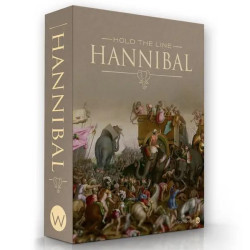
Hold the Line: Hannibal is a grand tactical two-player game covering 10 of the greatest battles of the Punic Wars. Following in the footsteps of Worthington’s Hold the Line series, Hannibal uses the same standard size map board, 13 hexes wide and 9 hexes deep. Combat is resolved with custom dice.
The game will be using glorious large full color double sided counters for your military units.
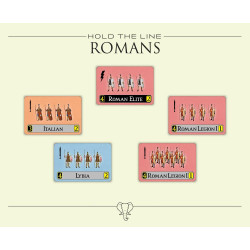
The scale is 300-400 meters per hex, 90 minutes per turn and units of 3-6,000 infantry, 2-4,000 cavalry and 15-25 war elephants. The units are mainly of 4-steps and include four types of infantry: elite, regular, barbarian and light; three types of cavalry: regular, barbarian and light; and, of course, war elephants. Some units have missile capability, which enhances lethality in combat.
Hold the Line: Hannibal introduces several innovative features:
- Facing: Most importantly in a depiction of ancient combat, facing plays a major role in
movement, reaction and combat in Hannibal. Units face a hex vertex and have two front hexes, two flank hexes and two rear hexes. Movement and attack are restricted to front hexes, while defending against flank or rear attacks is penalized.
- Formations: The Action Point (AP) mechanic is retained from Hold the Line. However, an original command system features formations of one to six units in Hannibal. Most armies have a center and left and right wings of infantry, with two cavalry wings. Each formation is activated in turn by a chit pull system, introducing uncertainty and fog of war.
- Leaders: Formations are led by over 30 of the famous historical leaders of Carthage, Rome and Numidia with varying capabilities and limitations. In Hannibal, leaders are required to activate units of their formation based on their command range. Leaders may provide battle bonuses in combat and retreat; rally weakened units; and seize the initiative overruling the usual chit pull order. Leaders can also be killed or captured.
10 battles of the Punic Wars between Carthage and Rome.
Bagradas 255 BC
Trebia 218 BC
Trasimene 217 BC
Cannae 216 BC
Dertosa 215 BC
Baecula 208 BC
Metaurus 207 BC
Ilipa 206 BC
Great Plains 203 BC
Zama 202 BC
Components:
Beautiful sturdy game box
22 x 34" large mounted board
2 or 3 sheets of terrain tiles (*depending on sheet layout)
3 sheets of Large Roman and Carthaginian units with rounded corners
Custom Battle Dice
2 sets of rules, one for each player.
2 scenario books one for each player with set-up instructions, deployment maps and historical background fo each of the 10 battles.
Custom counter tray
Edición en inglés.